I sympathise with those who have pledged their support to Don't Pay UK and similar movements. The spirit of no longer just grinning and bearing the problems imposed on them by agents of charlatanry has ignited inside them, and they have organised. Strength in numbers is a powerful play, and the play that neither the government nor any other organisation can play, for we outnumber them on such a grand scale when properly coordinated to achieve a common goal. But, unfortunately, those tens of thousands of rebels with a cause — perhaps even a million by October 1st if they hit their target — are misguided in who their enemies truly are, and thus any solutions they propose are destined to be temporarily relieving at best and permanently counter-productive at worst.
The demands put forward by Don't Pay and other such movements are the government should intervene in the private affairs of energy companies and dictate to them how much they can sell their own services for and subsidise them for their losses, which is to say giving one's already stolen money, i.e. taxes, to energy companies so that they don't need to charge customers so much (price caps); as well as the government should either steal from these companies, i.e. tax them, and give this money back to their customers to financially assist them with paying for such necessities (windfall tax), or they should force these companies to surrender their profits over to whomever they believe should have it through legislation, i.e. at gunpoint. What this amounts to in simple terms is "the government should rob from us to give to them and the government should rob from them to give to us."
This is a short-term, illusory solution to — if one persists with applying political solutions — an indefinite problem. It may seem to one who has pledged to participate in such an act of rebellion to be just that, an act of rebellion, but it is in actual fact equivalent to disobeying one's masters because one is not made to obey them hard enough — "rule me harder, daddy."
One must first realise that any solution to any problem through political means simply expands the purview and abilities of government; and one must also realise that anything and everything government does is funded by money stolen from the population it resides over — taxation. Therefore, demanding government action is the act of surrendering more of one's own choices to be made instead by government, and any solution government will apply will be an exercise in increasing the amount of stolen money in circulation, which, put simply, is robbing from oneself to give to others and robbing from others to give to oneself: the redistribution of wealth. This is not a rebellion: this is begging.
One must also recognise that their fury is entirely misdirected. No business on the free market possesses the power of monopoly. Monopoly is only possible through government intervention in the free market on behalf or to the advantage of the wannabe monopolist, which is any and all businesses by their very nature — corner the market, set an exorbitant price because customers have lots of need and no alternative for their supply, reap the profits. It is this intervention that creates such environments as we experience now in the form of a lack of choice (in this case of energy source, not supplier, since they all use the same unreliable energy source: renewables), outlandish prices, and the exploitation of such circumstances — profiteering — by energy companies. Without artificial interference in the free market, such as creating and sustaining a proxy war (higher taxes), placing economic sanctions on a country we trade with (higher prices), outlawing energy independence and supplanting it with dependence on foreign energy sources (even higher prices), forcing energy companies through taxation and regulation into using green (renewable) energy in spite of its evident inefficiency and therefore low supply to meet high demand (even higher prices again), and all the while engaging in increasing amounts of mass theft, i.e. taxation, of the population and private business alike to fund such projects (even higher prices again for customers, whilst having dwindling amounts of money left to pay such prices), none of these problems would exist or even be possible to exist. Leading a rebellion against private entities that can only realise such circumstances through leveraging the muscle of the mafia — government — or as a consequence of the mafia’s own activities (as it is today), albeit justified and understandable, is attacking the symptom and not the cause. That being the case, this approach will only yield short-term, temporary results. To put it bluntly, after the tumour of profiteering has been removed from the economy, the cancer of the government's hands in one's pocket still remains: the cancer hasn't been cured, it's just been prodded at.
If one is not convinced that government is entirely the cause, one need only ask themselves if they personally would have voluntarily created a proxy war on the other side of the world; if they personally would have voluntarily sent and continued to send their own money to sustain that proxy war; if they personally would have voluntarily stopped buying products and using services offered by a former trading partner and now enemy faction in that proxy war; if they personally would have voluntarily paid higher prices for goods and services in order to spite that enemy faction in that proxy war; if they personally would have voluntarily paid higher prices for green energy in exchange for inefficient and unreliable power; and finally, if they personally would have voluntarily handed over increasing amounts of their own hard earned money, in spite of their dire economic circumstances because of all these other factors, to an organisation that threatens them with violence if they decline to do so, i.e. government. If one's answers to these questions are no, no, no, no, no, and no, then one knows who is really responsible and deserving of their animosity and revolt.
Yes, energy companies have played their part in plundering one's wealth, but they were only able to do such a thing in an environment created by government. Without it, energy companies would have no such "act of government" to exploit and profit on the back of. It therefore stands to reason that increasingly less acts of government would mitigate the likelihood of such a wealth migration, as opposed to increasingly more as such "rebels" are on their knees gagging for.
And thus, finally, one must reach the epiphany that revolting while still operating inside the approved channels sanctioned by the powers that be to do so is by definition not revolting. Nothing will come of it but the short-term satisfaction offered by the government to dull one's appetite for revolution and stave off the threat of real change — an actual revolution.
So what is my counter proposal?
Don't pay taxes. And not temporarily: indefinitely. If one recognises the root of the problem, that all roads lead to government, then one must also recognise that to make those roads inaccessible, one must cease to maintain them. And that is what one does when one submits to paying taxes, they maintain the roads that lead directly to one's pocket. Cease to do that and these routes gradually become untraversable, until eventually they are completely so.
Yes, this is illegal. To deny the robber access to one's pocket is illegal, and so in order to defy the robber, one must become a criminal. The famous quote "if voting changed anything, they'd make it illegal" is applicable to any and all opposition to government activity. If one is to defy government, one is "authorised" to do so as long as it is from within the officially approved velvet ropes, which is to say on their terms. This is not change: this is illusion. And it is so because the only solution that is permissible to propose from within these velvet ropes, as one must have noticed, is a self-serving one: "government must do this" and "government must do that" is conveniently all one can “legally” propose, which translates to "government must have more responsibilities and therefore more power and influence over my life." To liberate oneself from these restraints, that is, to enact real change, is to do the opposite: to solve problems independently and privately amongst willing individuals, thus reducing the responsibilities of government, which in turn reduces the power and influence government has over one's life. If one desires change, one must make it themselves, outside of the confines of government — and to step out of the confines of government is to become a criminal.
Indeed, this strategy requires significantly more risk to oneself, and the reason no one has dared to suggest this is because it involves engaging in criminality — the criminality of keeping one's money in one's own pocket: the horror! To do anything but this is to revolt from safety, and, unfortunately, freedom is not safe, and so revolution is not safe. But consider this: the reason Don't Pay have convinced so many similarly disgruntled people, tens of thousands in fact, to pledge to defy energy companies on October 1st is because when done alone, one bares all of the risk, but when done in increasing numbers, one shares this risk with others, and this collective risk-taking actually reduces the risk for each individual risk-taker — strength in numbers.
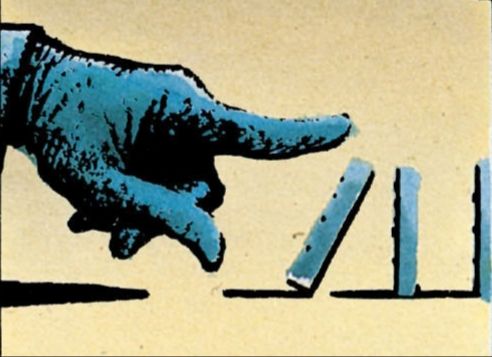
Many have cited the infamous poll tax — a tax calculated based on the number of people living in any one house, meaning higher taxes for larger households and lower taxes for smaller ones, affecting the lower classes more-so than the upper classes as the lower tend to live in larger households — and the revolt that followed in light of the similar dismay to which we find ourselves experiencing now when faced with rising energy prices. As many as 17 million are estimated to have participated in this act of disobedience, and history tells us of what can be achieved by such a coordinated effort. The reason this succeeded was because the government could not possibly enforce such a widely disregarded attempt at money collection, or in other words, there are many more of us than there are of them. And the number of dissidents does not even need to be so high. Even the one million target that Don't Pay have proposed before they take action is ambitious but not necessary. 17 million participants did not take part in disregarding the poll tax overnight. It was a gradual domino effect that eventually peaked at 17 million as more and more realised that the authorities could not possibly enforce such a tax, and so if all of one's neighbours are not being made to pay it, why should they?
Law without enforcement is meaningless, and all it takes is numbers to make enforcement impossible. If even the tens of thousands that have currently pledged to take part in this act of disobedience against their energy providers did so instead against the government, as I am proposing, a similar domino effect would occur as it did during the defiance of the poll tax. The consequences associated with engaging in criminality would decrease as the number of dissidents increase, and unlike defying a single tax, defying all taxes would cause the government, and therefore the enforcers of its law — police — to experience some financial hardships of their own. Without a steady stream of taxes to rely on, anything and everything they do to counter the revolt would cause them to haemorrhage money faster and faster — the more they do to try to stop the bleeding, the quicker they bleed out. And just as the domino effect applies to taxpayers, so too does it apply to government agents — without tax money, how will they pay the law enforcers? — and so too will they topple and merge into the dissident crowd. As the money tree, which is to say our collective pockets, dries up, so too does the government's capacity to pay their agents, fund their projects, and ultimately, sustain their existence. Now that would be a revolution I could dance to.